
Reef safe crabs play an important role in the health and longevity of a reef tank. Crabs are a natural part of a reef ecosystem since they help control algae, and they also consume uneaten food and debris from a sand substrate. Some crabs will even help control a cyanobacteria bloom before it takes over your tank.
However, if you add a non-reef safe crab to a reef tank they can quickly destroy your expensive corals, and some crabs will even kill fish and other invertebrates in your tank.
That’s why we put together this list of reef safe crabs, so you can quickly find the best crab for a reef tank.
Reef Safe Crabs
Blue Leg Hermit Crab (Clibanarius tricolor)
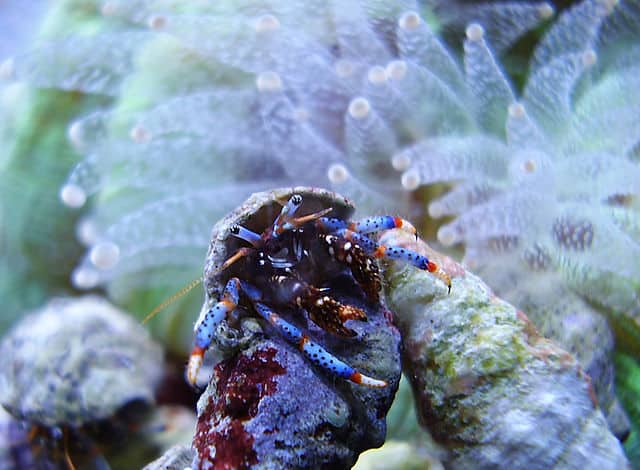
The Blue Leg Hermit Crab (Buy Online) has bright blue legs with red bands near each joint. They also have bright blue eye stalks and blue mouth parts that protrude from their shell. These brightly colored crabs also have a great personality, and they are a perfect fit for a peaceful community tank.
Blue Leg Hermit Crabs will grow to be about 1-inch long when they reach adulthood. It’s recommended that you keep a Blue Leg Hermit Crab in at least a 20 to 30-gallon tank (Buy Online) with plenty of shells for them to move into as they grow.
Blue Leg Hermit Crabs constantly scavenge a tank for leftover food and detritus to eat. They are also voracious algae-eaters, and they tend to leave hard coral and soft coral alone, which makes them one of the best reef safe crabs to keep for beginners.
Red Leg Cortez Hermit Crab (Clibanarius sp.)

The Red Leg Hermit Crab (Buy Online) has a vibrant red coloration that really stands out against a white sand substrate.
Red Leg Cortez Hermit Crabs are an active and outgoing crab that does well in a peaceful community tank. They will grow to a maximum size of around 1-inch long, and they will do best when kept in at least a 20 to 30-gallon tank.
Red Leg Hermit Crabs will scavenge for leftover bits of food like most hermit crabs, and they love to eat multiple types of algae.
Red Leg Cortez Hermit Crabs are also known as grazer hermit crabs, and they have a strong dietary preference for green hair algae and cyanobacteria. They also tend to leave coral alone which makes them one of the best reef safe crabs for a small to medium-sized reef tank.
Emerald Crab – Mithrax sculptus
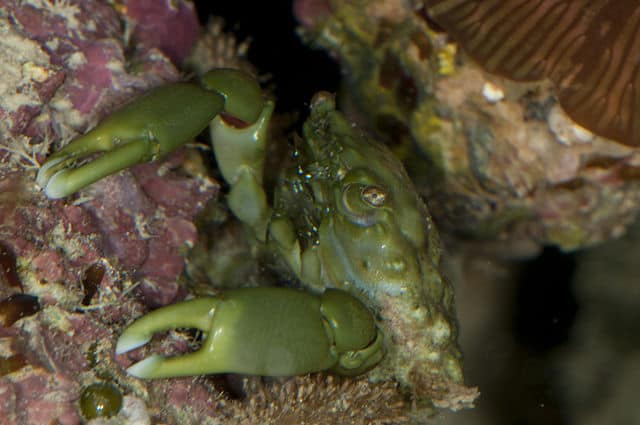
The Emerald Crab (Buy Online) is a very popular reef safe crab species that are great at controlling algae. They do best in a saltwater tank with lots of live rock and a live sand substrate.
Emerald Crabs are one of the most voracious algae-eating crabs you can keep in a reef tank, and they make a great addition to any cleanup crew. They are also especially effective at controlling bubble algae that most other crabs won’t eat.
Emerald Crabs can become aggressive if they don’t have enough algae to eat. If there isn’t enough algae in your tank you can feed them seaweed and meaty foods on a regular basis to control their aggression.
Emerald Crabs do well in peaceful community tanks, and they tend to leave coral alone, and they won’t harass their fellow tank mates as long as they have enough to eat. They also don’t grow that large so they can be kept in almost any size reef tank.
Arrow Crab – Stenorhynchus seticornis
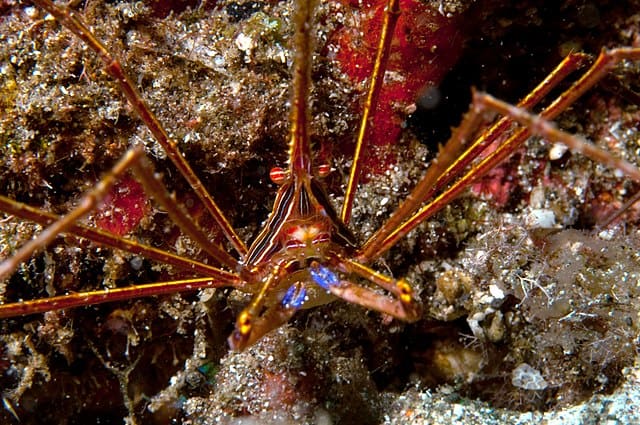
The Arrow Crab (Buy Online) has a head and body that looks a little like an arrow hence its name. It has very long spider-like legs, and the males tend to be bigger than female members of the species.
The Arrow Crab can be aggressive with members of their own species or other shrimp and crabs that have a similar morphology. That’s why it’s advised that you only keep a single Arrow Crab in a reef tank to avoid conflicts. They also grow up to six inches wide and they need to be kept in a larger tank.
The Arrow Crab can crawl very quickly thanks to their long legs, which they use to their advantage to attack slower moving prey. They have been known to attack other crustaceans like Banded Coral Shrimp, and they will even try to eat small slow-moving fish. However, they tend to leave coral alone so they are a reef safe crab, but you just need to be aware that you need to keep them with compatible tank mates.
Boxing Crab – Lybia tessellata
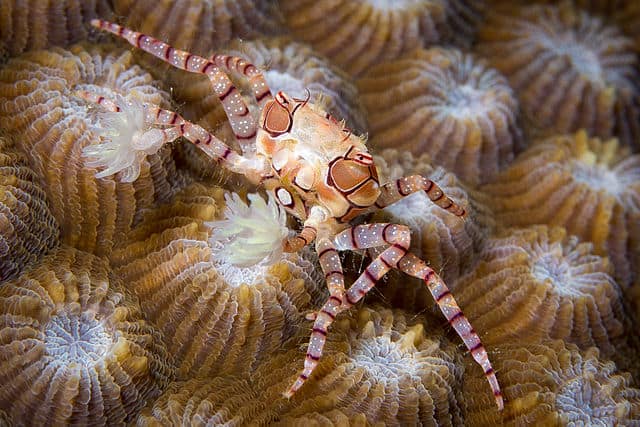
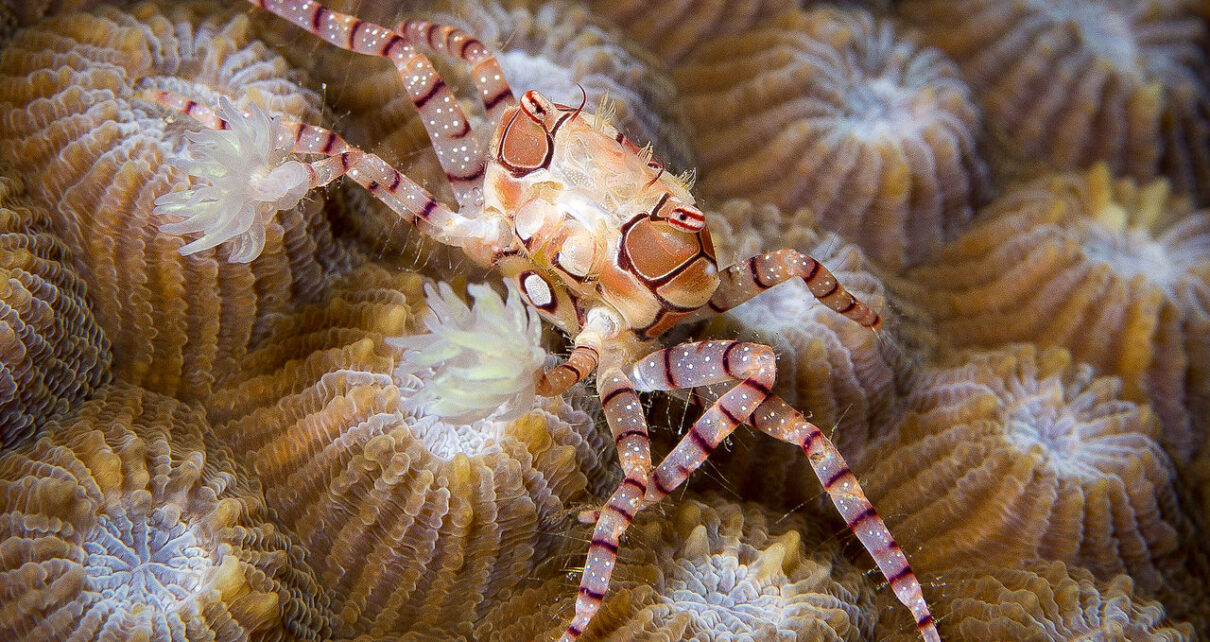
The Boxing Crab (Buy Online) is also known as the Pom Pom Crab, and it is one of the most interesting crabs that you can add to a reef tank. These crabs also remain small throughout their lives, which makes them a perfect fit for a nano tank.
Pom Pom Crabs are very peaceful crabs that won’t harm any of their fellow tank mates. However, they are pretty small, so they shouldn’t be housed with larger fish or other predatory inverts.
The Boxing Crab gets its name from the two small anemones it carries around like boxing gloves in both of its front claws for protection from predators. The anemones also act as a filter that the crab waves around to catch bits of food floating in the water column.
The Boxing crab then picks the larger food particles off the anemone, and the anemone also benefits from the relationship since it gets to eat the bits of food that are too small for the crab to eat
The Boxing Crab is reef safe since it prefers to use the anemones to filter feed, so they won’t get the urge to pick at corals like most crabs do when they get hungry.
Anemone Crab – Neopetrolisthes maculatus
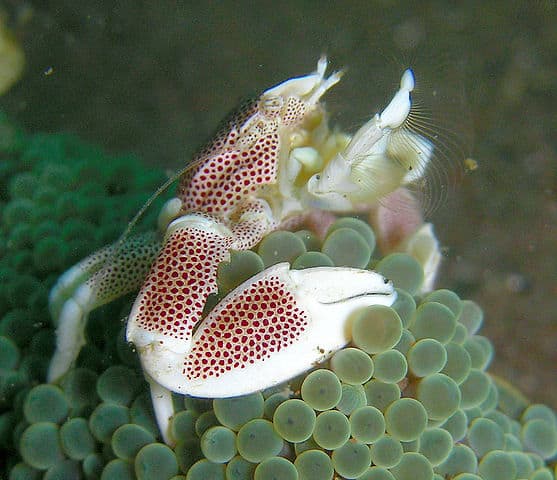
The Anemone Crab (Buy Online) has a bright white body that’s speckled with reddish-purple spots. They are a peaceful reef safe crab that gets along with a wide variety of tank mates.
Anemone Crabs are very easy to care for and they will help keep your reef tank clean since they love to graze on algae and scavenge for detritus.
In some cases, Anemone Crabs will pair up with an anemone and form a symbiotic relationship. In order for this to occur they need to be kept in a well-established reef tank with plenty of food for both the anemone and the crab to eat.
Anemone Crabs can be aggressive toward other invertebrates and they can be territorial. It’s a good idea to keep them in at least a 30-gallon tank with lots of live rock that has plenty of crevices that offer territory for them to claim.
Horseshoe Crab – Limulus polyphemus
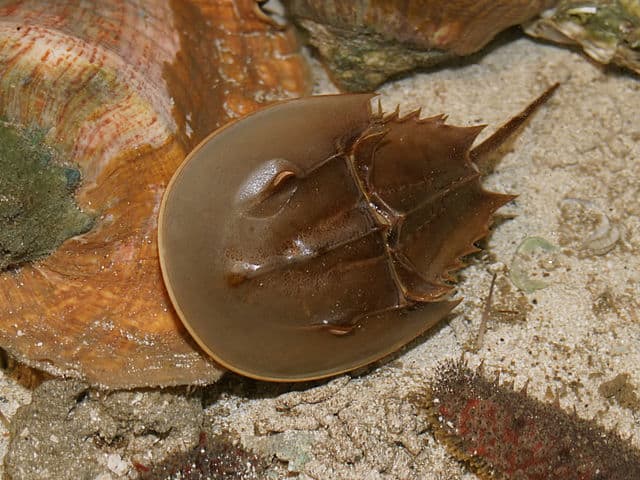
The Horseshoe Crab (Buy Online) is one of the most unique invertebrates that you can add to a reef tank. They are one of the oldest species currently living on the planet and they have survived numerous mass extinctions, which makes them one of the most bulletproof invertebrates you can keep.
Horseshoe Crabs aren’t actually crabs instead they are more closely related to spiders and scorpions. They also have blue blood which uses copper based hemocyanin to carry oxygen instead of iron-based hemoglobin. Their blood is also used in medical research to test for contamination since it immediately clots and encapsulates any foreign material as a way to protect against bacterial infections and disease.
Horseshoe Crabs like to be kept in a reef tank with a deep sand bed since they like to burrow for food and to find a safe place to sleep. This makes them one of the best sand aerators since they can turn over a lot of sand with their powerful legs and shovel-like bodies.
Horseshoe Crabs primarily feed on algae, worms, and other large meaty bits of food on the substrate. When they are young they completely reef safe, but as they get larger they might cause problems if they are kept in a small densely stocked reef tank.
Orange Leg Hermit Crab – Ciliopagurus strigatus
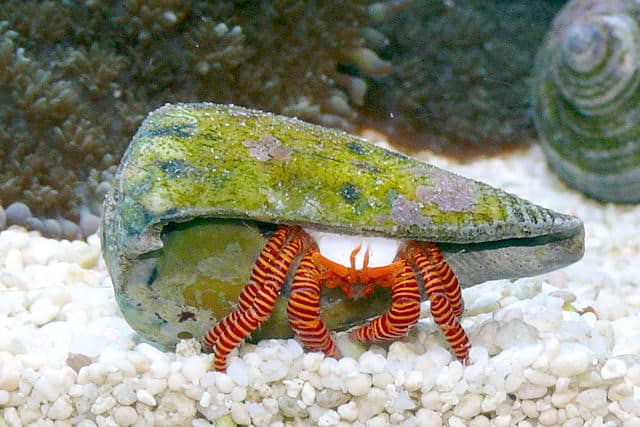
The Orange Leg Hermit Crab (Buy Online) also goes by the more festive name Halloween Hermit Crab. It is one of the most striking hermit crabs with bright orange legs with dark red stripes spanning the full length of their legs.
The Halloween Hermit Crab is native to the waters of the Indo-Pacific and it’s primarily found off the shores of Hawaii. They also get larger than other hermit crabs, and you can expect that they will reach a maximum adult size of two inches.
Halloween Hermit Crabs also tend to be more aggressive than other hermit crabs, so care should be taken when selecting compatible tank mates. To keep aggression to a minimum Orange Leg Hermit Crabs should be fed meaty foods especially when there isn’t enough algae and other food for them to eat.
Zebra Reef Hermit Crab – Calcinus laevimanus
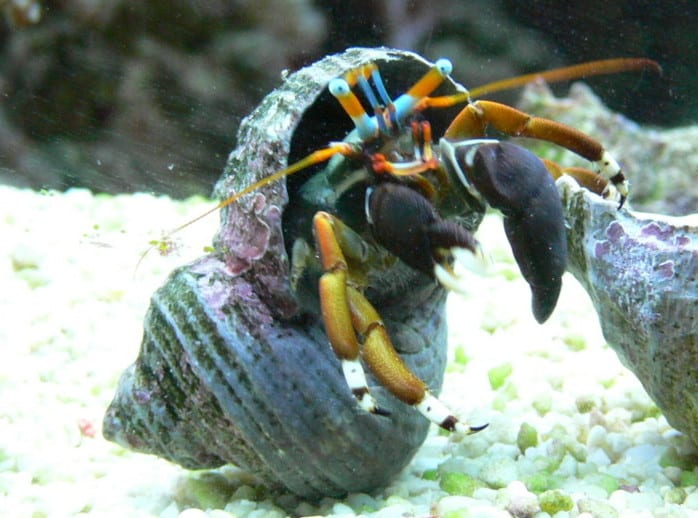
The Hawaiian Zebra Hermit Crab (Buy Online) is also known as the Left-Handed Hermit Crab. They have large black and white banded claws with a larger left claw hence the name.
Left Handed Hermit Crabs are reef safe algae-eaters, and they will help aerate the sand bed in a reef tank in their search for detritus to eat. They are also very peaceful crabs, and they don’t grow to a large size, so they can be kept in almost any size aquarium even a 5-gallon tank (Buy Online).
Electric Blue Hermit Crab – Calcinus elegans
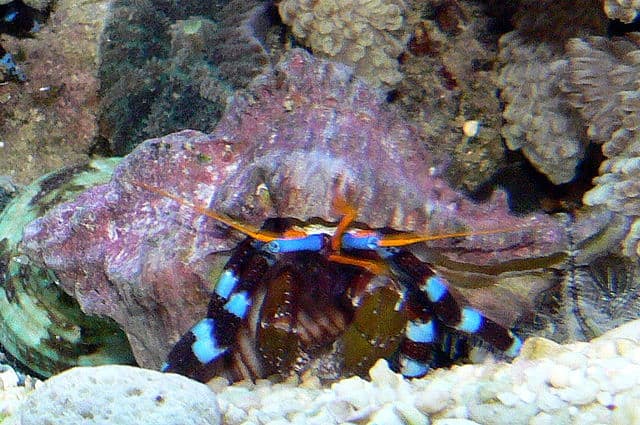
The Electric Blue Hermit Crab (Buy Online), is a dwarf hermit crab with tiny bright blue legs. They make a great addition to any cleanup crew, and they are very easy to keep. They are also very peaceful, and they are completely reef safe.
They do a great job of removing algae from live rock since they can easily get into tight spaces. Also, they will help keep the substrate clean in a reef tank since they will quickly clean up any uneaten food and debris.
Blue Eye Hermit Crab – Paguristes sericeus
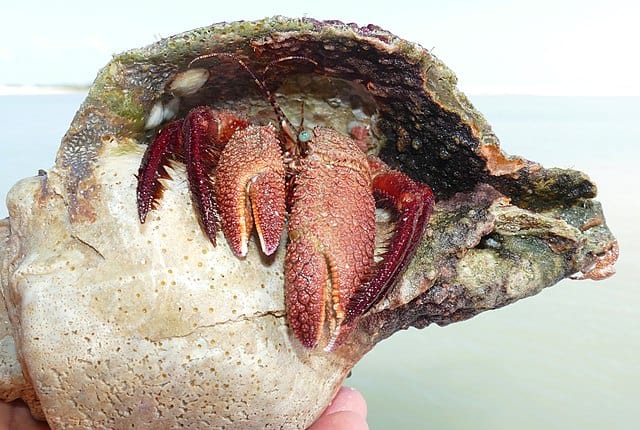
The Blue Eye Hermit Crab (Buy Online) is an interesting hermit crab that has bright blue eyes juxtaposed against a light pink body. They are also relatively rare since they are only naturally found in a small habitat off the shores of the Marshall Islands.
The Blue-Eyed Hermit Crab is reef safe, and it gets along well with other fish and invertebrates when kept in a peaceful community tank. They do a great job of eating algae, and they will also help turn over a sand substrate in a reef tank.
Trapezia Pocillopora/Acropora Crab
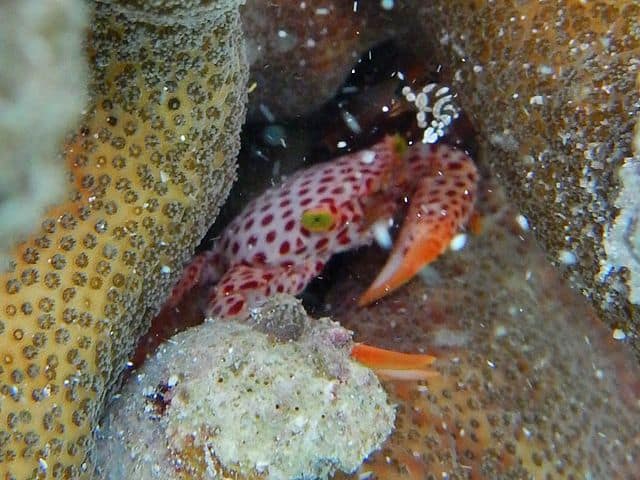
The Acropora Crab (Buy Online) is a special little crab that has evolved to live in hard coral for its whole life. They prefer to live in Pocillopora corals, but they will accept Acropora Corals if there are no Pocilloporid present in their environment.
The Acropora Crab helps maintain coral health in a reef tank by keeping the many branches of an Acropora coral clean and free of debris. This helps increase the water flow between the branches, and as we all know Acropora corals need a strong current to thrive in a reef tank.
The Acropora Crab primarily feeds off trapped food particles and debris that get lodged in the coral. But they have also been observed feeding on the mucus secreted by their host coral when they get hungry.
The coral also gets other benefits besides the cleaning service since the crabs will protect the coral from predators, and they will eat some invasive coral pests as well.
In the past, Acropora Crabs were considered a “pest” but they have proven to be beneficial members of a healthy reef community. It has also been noted that corals hosting Acropora Crabs have higher survival rates and stronger growth than corals that are Acropora crab free.
The Acropora Crab should only be added to an established reef tank with well developed Acropora corals. If they don’t form a commensal relationship with a mature Acropora coral they’ll have a hard time surviving in a reef tank.
Red Leg Hermit Crab – (Clibanarius diguetti)

The Red Leg Hermit Crab (Buy Online) has a subdued red color with light red pinkish legs. They have the same great personality as most of the other hermit crabs on this list, and they are very outgoing so they won’t stay hidden all day.
Red Leg Hermit Crabs constantly scavenge for food and while doing so they help turnover and aerate stagnant sand substrates. They also eat many different algae species, and they can even help control cyanobacteria outbreaks.
Strawberry Crab – Liomera sp
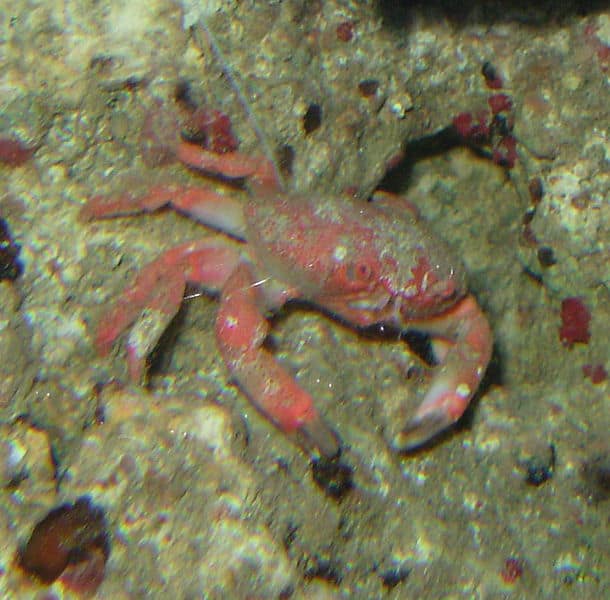
The Strawberry Crab (Buy Online) also goes by the name Red Boxing Crab, and it hails from the beautiful blue waters off the coast of Hawaii. They have a bright pink shell that’s covered in tiny white spots, and they have large front claws that are specially adapted to pick algae off rocks.
Strawberry Crabs do well in aquariums with plenty of live rock for them to pick at and scavenge algae, and they also like to hide in crevices to feel safe. They tend to get along well with most fish, and they will tolerate most invertebrates
They will eat a wide range of food including meat so they do a good job of cleaning uneaten food off the bottom of a reef tank, But they are primarily herbivorous, so if your tank doesn’t have enough algae you might have to supplement their diet with seaweed.
Sally Lightfoot Crab – Percnon gibbesi
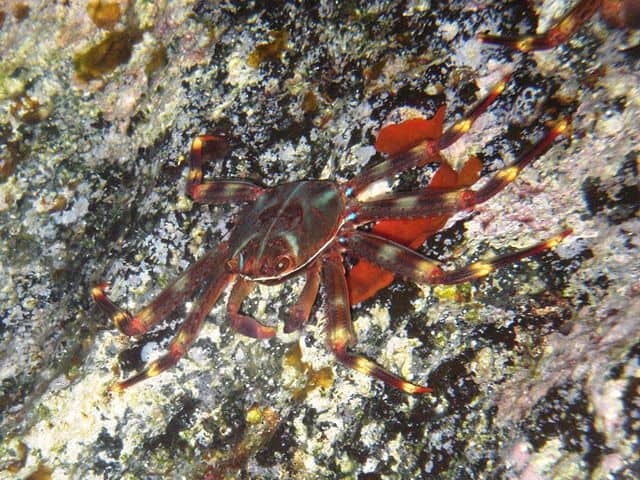
The Sally Lightfoot Crab (Buy Online) is a unique crab the goes by many names. It’s sometimes called the Nimble Spray, Short, or Urchin Crab, and it has a brown shell with yellow and orange bands on its legs.
The Sally Lightfoot Crab is descended from shore crabs, but it primarily lives in the sea, so it can live on land for short periods, but there is little risk that it will try to escape from a reef tank.
The Sally Lightfoot Crab has evolved to hide in tight crevices since they have a flat carapace, and they can be hard to spot when they find a hiding place.
The Sally Lightfoot Crab needs to be kept in a tank with a strong current, and of course, they need lots of live rock to take refuge in and to scavenge for debris. They will eat small amounts of algae but they primarily eat detritus that builds up in the rock work.
The Sally Lightfoot Crab can become aggressive when they get older, and they have been known to eat small fish. For this reason, they should only be kept in reef tanks with large fish and other similarly sized invertebrates that can effectively defend their territory.

![Best Filter for an Oscar Fish Tank Oscar fish are voracious eaters that can grow to be up to 14 inches long. They need a lot of space and a big tank, but they also need good filtration. This is because Oscars produce a large amount of waste for their size, which can quickly pollute the water if not managed properly. Read on to see the best filter for an Oscar fish tank. [toc] Best Filter for an Oscar Fish Tank ***TABLE**** Best Filter for an Oscar Fish Tank OASE Indoor Aquatics Biomaster Thermo 600 The Aquatics Biomaster Thermo 600 Filter (Buy Online) has everything you need to keep water clean and healthy for your fish, plus some cool extra features too. It comes with four different filtration stages that remove debris from the water so your tank stays clear and safe for your fish to live in. Plus, it has a built-in heater which keeps the temperature of your tank consistent so you don't have to worry about fluctuations or sudden changes affecting your fish. The OASE Indoor Aquatics Biomaster Thermo 600 is a reliable and high-quality filter that will keep your water crystal clear. It has four stages of filtration, including a pre-filter module for particle removal, two main filters to clean detritus from the water before it reaches the pump area, an activated carbon stage with 45 ppi pores to trap organic chemicals and reduce odors, and finally a polishing cartridge which traps any particles left after the other three stages have removed most of the large debris. Plus, it comes with Hel-X Biomedia that has an extremely large surface area for beneficial bacteria colonies that break down nitrogenous waste. Overall, this filter can be used on 70 to 160 gallon tanks, and if you want peace of mind about how well your tank is being filtered and heated – this canister filter is perfect for an Oscar tank. Eheim Pro 4+ 600 Filter The Eheim Pro 4+ 600 Filter (Buy Online) is the best filter for an oscar fish tank because it’s easy to use and maintain while providing a high level of filtration. It has a self-priming pump that makes starting up very simple, plus its safety hose adapter means you won’t have to worry about any accidents with this unit. We recommend going with their Pro 4+ model which has been designed specifically for tanks containing Oscars and other larger species of fish. This filter comes with everything you need including extra media baskets, spray bars, adjustable flow control valves, and more. Polar Aurora 4-Stage External Canister Filter 525GPH with 9-watt UV Light The Polar Aurora External Canister Filter (Buy Online) is an affordable yet high-quality canister filter and it has four stages of filtration (biological, mechanical, chemical and UV) that keep your fish tank crystal clear without taking up much space. If you have an Oscar Fish Tank, then you know that they are messy fish. They produce a lot of waste and your tank needs to be cleaned frequently. That's where this filter comes in handy. It can handle tanks up to 200 gallons and has a maximum flow rate of 525GPH from the built in pump. This is more than enough power for even the messiest Oscar Tanks. This unit also comes with three different media trays so you can use any type of filtration media you want - bio balls, sponges or ceramic rings. And not only does this filter provide excellent water filtration, it comes with a built in 9 Watt UV Light that allows it to easily control algae spores/bacteria and maintain clear water in your aquarium at all times. Fluval FX4 High Performance Canister Filter, External Aquarium Filter The Fluval FX4 (Buy Online) is an external filter designed specifically for aquariums housing oscars and other large tropical fish species like cichlids and catfish. There's also three different filtration stages included in this setup which will ensure that all the waste produced by your fish gets filtered out quickly leaving behind crystal clear water every time. The Fluval FX4 is the best aquarium filter on the market because it has a patented self-priming pump that moves 700 US Gal of water per hour. It also comes with all of the media you need to get started filtering your tank immediately after installation - no extra purchases necessary. This external aquarium filter is easy to install, maintain, and clean. With its multi-stage filtration process this canister filter removes harmful toxins from your water while providing superior mechanical filtration through three stages of bio-filtration using BioMax cartridges, activated carbon pads and biological ceramic rings . This powerful filter pumps out 700 US Gal (2650 L) of water per hour so it's perfect for even the largest freshwater or saltwater tanks up to 250 US Gal (900 L) Best Hang On Back Filter for an Oscar Fish Tank AquaClear Fish Tank Filter, Aquarium Filter for 60- to 110-Gallon Aquariums The AquaClear 110 (Buy Online) is a hang-on back filter that has an adjustable flow rate, and it'll last you for years. AquaClear filters make it easy, convenient, and affordable to keep your tank clean without all of the complexity and hassle of a canister filter. The AquaClear 110 filter has been designed with the hobbyist in mind; and it provides superior mechanical, chemical as well as biological filtration media at an unbeatable price point. It's ideal for aquariums up to 110 gallons (416 liters) in size and it has a flow rate of 500 U.S. gallons per hour (1,900 L/h). SeaChem – Large Aquarium Fish Tank Filter, Tidal 110 Gallon The SeaChem Tidal 110 Gallon Aquarium Filter (Buy Online) is one of the few hang on back filters specifically designed for Oscars and other larger tropical fish tanks (up to 110 gallons). This means that it has more than twice the capacity of other hang on back filters so there's no need to clean out debris as often. It also has an adjustable flow control valve - just set the dial where you want it and let the self-priming pump do its job. You can also use any kind of filtration media without worrying about clogging since the patented impeller design keeps everything running smoothly Best Sponge Filter for an Oscar Fish Tank Bacto-Surge Hikari Aquarium Solutions Foam Filter, 125 Gallons Bacto-Surge Foam Filters (Buy Online) are made from a durable foam material which allows them to last much longer than traditional sponge filters. They also don't require any electricity or have any moving parts, so you can use these as a cheap and reliable way to supplement the filtration in your Oscar tank. Best Under Gravel Filter for an Oscar Fish Tank Lee's 125/135 Premium Undergravel Filter, 18-Inch by 72-Inch Lee's 125/135 Premium Undergravel Filter (Buy Online) is the best you can get for an Oscar fish tank. It has a multi-level plate design made of high-quality plastic, so it lasts longer than standard models. And this under gravel filter can also be used to build an anoxic filter to lower nitrates, which improves overall water quality and it will also help keep your fish healthy and disease free. Best Filter Media for an Oscar Fish Tank Premium Authentic Pinky Filter Floss for Fish Tanks Premium Authentic Pinky Filter Floss for Fish Tanks (Buy Online) provides two layers of filtration to keep your tank cleaner & running more efficiently than ever before. It's made in the USA from high-quality materials that are safe for both fish and humans alike. It also reduces maintenance time because it lasts 2x as long as other brands on the market today. AQUANEAT Aquarium Filter Sponge Open Cell Foam Sheet Bio Sponge Filter Media Pad Aquaneat's Black Fine Filter Sponge (Buy Online) is made with natural materials that are non-toxic and safe for fish & plants. It provides mechanical filtration by trapping dirt particles in the pores of the sponge material so they do not get through into your aquarium water where they could cause harm to your aquatic pets. The open cell structure of the Aquaneat Sponge means you can simply rinse it under running water when needed instead of having to replace expensive filters every few weeks. And we've tested these pads with many different types of tanks and they are one of the most durable and economical ways to keep the water in a fish tank free of debris. Seachem Matrix, 4 L / 1 gal. Seachem Matrix (Buy Online) removes ammonia, nitrite and nitrate from the water column in freshwater tanks through a process called denitrification. It does this by providing an environment where beneficial bacteria thrive and convert harmful toxins into less harmful forms (even anoxic bacteria that break down nitrates). This process reduces stress on aquarium inhabitants by reducing their exposure to these toxins while also maintaining pristine water quality in your aquarium Eheim AEH2507051 Mech Filter Media for Aquarium, 1-Liter Eheim Ceramic Cylinders (Buy Online) are reusable so you don't have to waste money on disposable filter cartridges or sponges every time you clean your tank. Simply rinse them out in decholorinated water when they get clogged, and you can reuse them indefinitely. Oscar Fish Tank Size A 70 gallon tank will work for an Oscar, but it's better to keep them in a 100+ gallon tank. The bigger the better. More space promotes greater health while also keeping them happier which in turn reduces the risk of stress and disease. Oscar Fish Water Parameters Oscar Fish Water pH Level Oscars prefer water with a pH between 6 and 8, but they prefer slightly acidic water and they can live in water that has a pH as low as 5.5 quite comfortably. Oscar Fish Nitrite Level The nitrite level in your tank should be at 0 ppm once your tank has cycled. Nevertheless, a weekly 10% water change with fresh water from the tap is always good early on in the cycle to reduce nitrites. Oscar Fish Nitrate Level To keep your Oscar healthy you want to keep your nitrate levels between 10-40 ppm. It's important that you test the water with a Nitrate Test Kit (Buy Online) to ensure the nitrate levels in your tank aren't reaching dangerous levels. If the nitrates in your tank stay consistently over 40ppm, it’s time to clean or replace old filters, clean out uneaten food, vacuum the gravel, and do at least a 25% water change. Oscar Fish Water Temperature The ideal water temperature for Oscars is 75-80 degrees Fahrenheit (23 - 27 Celcius). It's important to remember that Oscar Fish are from the Amazon Rainforest and they need a heater in their tank especially during the winter time If you want to know what size heater you need for your tank you can use our Fish Tank Heater Calculator (Click Here) Oscar Fish Water Change Water changes are an essential part of fish keeping for any type of fish. This is especially true when you have larger fish like oscars that produce more waste. Water changes, or partial water changes, should be done every 1-2 weeks depending on how many fish you keep in your tank Why Is My Oscar Fish Tank Cloudy Fish tank water can become cloudy for a few reasons. The most usual is that the aquarium is either experiencing a bacteria bloom or there is algae in the water column. If this is the case, you’ll need to do a 50%-75% water change immediately. You can also use an inline UV filter if water changes and regular tank maintenance aren't getting control of your cloudy water problem. How To Keep an Oscar Fish Tank Clean Water Changes Vacuum the Gravel Bed Cleaning the Filter Removing uneaten food from tank Check for any algae growth on plants or glass walls of aquarium and clean as needed Test the water regularly Do Oscar Fish Need a Filter Yes, Oscar fish need a filter because they are messy eaters that produce a lot of waste. The filter helps with this issue and also improves the water quality by converting harmful ammonia into less toxic nitrates.](https://thepetsupplyguy.com/wp-content/uploads/Best-Filter-for-Oscar-Fish-Tank-464x290.jpg)